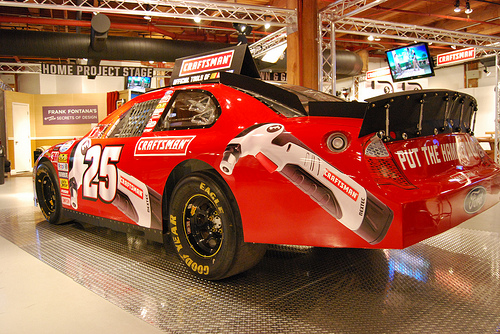
How NASCAR Uses Relationship Marketing

Nascar

I am the first to admit I am not the biggest NASCAR fan – by a long shot. I am however, a huge fan of any brand that uses relationship marketing to better engage with its fans.

Such is the case with NASCAR, who recently re-launched their digital platform. Seeing the need to engage and relate to their very large and impressive list of fans, they entered into an agreement with Livefyre, the leading provider of real-time social software which allows fans to have conversations in real-time across NASCAR.com, whether it be on a PC, tablet or mobile device, to discuss everything NASCAR from the latest in-depth news to live action on the race track.


Read more

Real-Time Marketing: 4 Best Practice Examples of Getting It Right at the Right Time

Amazon, Walgreens, eBay, and Netflix—you know these companies. And if you’ve done business with them, or visited their websites, they know you, too. Not everything, of course—that would be creepy.  But they probably know more than you think; they probably placed you in a category or two; and they probably know you watch spy thrillers on the weekends and order four pairs of shoes for your kids to try on, but that you usually keep just one. Even though it seems invasive on the surface, you’re probably just fine with it. Why? Because they take that knowledge and enhance your experience using real-time marketing—at the right time.


The following marketing executives all know how to use real-time data to solve problems, offer support, and make recommendations based on your needs and interests. They have helped their companies establish customer loyalty by engaging in the proper context and allowing customers to feel control over the message, which leads to an emotional attachment with the brand and at the very core—a Return on Relationship.

Read more

Social Business Strategy: Vision, Purpose and Value drive a new era of digital engagement

shutterstock_115494613

In an era when media is largely created and broadcast by the few to the many, social media emerged to facilitate the co-creation of media in addition to creating it. While difficult to trace its origins, the philosophy of social media dates back to the mid-1990s. It wasn’t until the mid 2000s however, that businesses would encounter the idea of a new medium where brand democracy prevailed over brand dictatorship.

Suddenly the voice of the customer took on an entirely new meaning and the promise of customer-centricity and engagement was thrust into the spotlight. But after all these years, businesses remain confounded. Even though most are experimenting with social media, how it improves relationships while impacting important business metrics is persistently elusive.

Read more

Controlling the Ideavirus

Dennis O. Smith wrote in with this question about Unleashing the Ideavirus: “I understand the concept of spreading the idea, but how can you control or direct that growth? ‘Going viral’ is great for fast growth and sharing of your idea, but are there mechanisms to steer it, trim it, shape it, etc.”

The reason that so many people catch a cold every year is that no one is trying to control where it goes. The reason that Wikipedia is so robust is that control is decentralized. The reason that there’s a huge disconnect between corporate marketing and ideas that spread is that the culture of contagious ideas is anethema to the command, control and responsibility mindset of the industrial marketer.

Read more

Is The Social Media Slumber Finally Over For Big Brands?

Perhaps it is because I am the father of a 13-year old daughter but whenever I hear the word “slumber” I immediately think of the phrase “slumber party” – which then conjures up fun, unless of course you are the host parent of said party.

However, if you’re a big brand, say on the level of a Fortune 500 brand, your “state of inactivity” – AKA your slumber – when it comes to social media, may finally be over. At least it may finally be over for some as that’s the indication one gets from reviewing data from a recent study from the University of Massachusetts Dartmouth Center for Marketing Research.

Read more

Most People are “Lurkers” in Social Media…

HEART-LURKER


Most people are “lurkers” in social media. They are consuming your content but not responding. You are still building a relationship with these people, and they “do” participate… it is just vicariously via those who do engage and interact.

There are many lurkers, searchers and readers who may never interact, or even post, but still have a great deal of value.

Read more

Why Twitter is My Favorite Social Platform


Twitter gives you a view into what anyone and everyone is talking about, the ability to easily build a following, and immediacy.

I believe Twitter is a tool that leads to other forms of social sharing. I consider Twitter a place to lay the groundwork where other people pick up things.

Read more

Most C-level Executives, CMO included, view “Social” as media—but they don’t know how to interact with consumers there in a meaningful way. They want to buy CPMs or Likes—but don’t know what to do with them afterward.

CMO’s also make the mistake of assuming that the social audience has the same pain and passion points as their face-to-face or store audience. Most often that is not the case.

In order to get the real value out of Social, you must connect emotionally to the people who are there and find out what they’re looking for. CMOs are used to ads and campaigns, so that’s the place they gravitate, but even Facebook ads are only media buys. Ads are good for building initial likes, but they really are targeted to demographics just like any other ad.

Read more