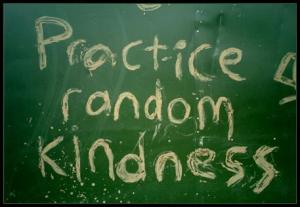
 I am a big believer that doing good, and just being nice to people, begets good treatment in return (part of that “Return” on Relationship)… for the most part. Therefore there is a return, just not necessarily from a particular act or specific relationship. I am not referring to this in a spiritual or cosmic sense. What I mean is that by building a reputation for putting yourself out (whether as an individual or a brand), doing good for others without expectation of something directly in return from that person, and generally being nice will most definitely add to your life in so many ways. People will notice, talk about it, spread the word, and in general most will treat you better, do for you, and watch your back because of the way you treat people.
This is not just a theory, but something I have put into practice personally and professionally. I make it a part of my daily life, try to help brands to understand, and have had a great deal of personal success and fulfillment in this respect. And yes, this is a basic tenant of Return on Relationship™ …simply put the value that is accrued by a person or brand due to nurturing relationships. ROI is the specific measurable, $’s and cents value, ROR is the value (both perceived and real) that will accrue over time through loyalty, recommendations, sharing and trust. A “Brand” is what a business/person does, and a “Reputation” is what people remember.
Be Good To People and Just Be Nice… for no apparent reason other than it makes the world a better place, makes you feel good, and will benefit you in the long run. Shoot me… I am altruistic 
“People will forget what you said, people will forget what you did, but people will never forget how you made them feel.” ~Maya Angelou
Originally posted at TedRubin.com
 You’ve heard the old adage “Stop tosmell the roses,” right? Well, I’ve come to learn that when life hands you those “moments,” it’s best to slow down, savor them and commit them to memory. They only come around once! And when you make a conscious effort to put yourself in that moment and really experience it with all your senses, you can recall that memory in an instant, and “re-savor” it. How can this relate to your business? Let’s try a little experiment. Close your eyes and think back to a particularly happy moment in your life. Picture where you were, what you were doing, and who was with you. What happens when you think hard about that moment? Are the details sharp and clear? I’ll bet that for those really good memories, you can even recall smells and the sense of touch or taste—things that trigger an emotional lift and make you smile. Now think about when you last had a fun experience while shopping. Perhaps you were at an event,or browsing a brick-and-mortar store… what products come to mind? What details do you remember about the experience? When you’re thinking about “branding” your business (and it doesn’t matter if you sell cupcakes or care-giving services), think about providing your customers with the kind of experiences that they will want to savor, because that’s a foot in the door to building a long-lasting relationship with them. What can you do that will make them want to stop and savor your “moments?”
 Every business needs content in order to be found in search, and to differentiate them from the competition. Without quality, helpful content (and lots of it), you’re lost in a school of fish that are all the same color. Who’s going to find you? Who’s going to pick you?
 Scary Fact: Did you know that 56% of top brands did NOT respond to customer comments on their Facebook page in 2011? — A.T. Kearney
 You say you want to get closer to customers, but your actions are different than your words.
 I had a stint one summer in my early twenties as an Executive Assistant to a CEO. Most of my role involved “managing” the CEO’s inbox. That meant printing out every email.
 This past week, I attended the IBM Smarter Commerce Global Summit, which was held in Madrid, Spain. As part of the IBM Smarter Commerce Global Summit, I led the Marketing Innovation Summit which brought together marketing professionals to network and discuss best practices. Of the 1,700 conference attendees, more than one thousand came from marketing backgrounds, providing a rich and in-depth conversation surrounding best practices for marketing effectiveness.