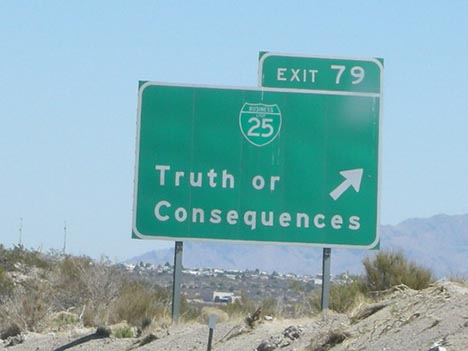
Truth and consequences

There’s a huge chasm in most markets: People who want to be isolated from the consequences of their actions, and those that are focused (sometimes too much) on those consequences.

For years, Paula Dean sold cooking shows to an audience that refused to care about what would happen if they regularly ate what she cooked.

Rep. Anthony Weiner wasn’t open to buying warnings about what would happen to his photos and tweets.

At the same time, there’s the audience of new moms that are overeager to baby-proof their home (just in case), the conscientious recycler who doesn’t want to know about the actual costs of picking up that bin out front, and the passionate teacher who sacrifices every day so his students can thrive a decade from now.

If you are selling tomorrow, be very careful not to pitch people who are only interested in buying things that are about today. It’s virtually impossible to sell financial planning or safety or the long-term impacts of the environment to a consumer or a voter who is relentlessly focused on what might be fun right now.

Before a marketer or organization can sell something that works in the future, she must sell the market on the very notion that the future matters. The cultural schism is deep, and it’s not clear that simple marketing techniques are going to do much to change it.

Seth Godin

Originally published on This is Seth’s Blog

Why Do Customers Use Social Networks for Customer Service? Because They Can…

Every day, an increasing number of connected consumers are taking to social networks to ask for help or express sentiment related to business or product related experiences; some do so to seek resolution from their peers, others broadcast questions or comments as a form of catharsis; and a smaller group of consumers actually hope to receive a response directly from the company. The reality is that social media is the new normal. A myriad of social networks, whether you use them or not, are now part of the day-to-day digital lifestyle with Facebook, Twitter, Yelp, Youtube among others becoming the places where your customers connect, communicate, and engage around experiences. They take to these social networks and more because they can. The question is, what are you going to do about it?

Read more

Listening to Me or Doing Something Else?

Social skills have suffered a great deal not necessarily due to “social media” per-say, but because of all the electronics we all carry and are addicted to in our daily lives. It did not used to be so easy to ignore people and seem disinterested because there was not much else to do during a meeting or when in a group. Now we have the world at our fingertips, so it is incredibly important to make it known to people what is acceptable and what is not. For instance when I am speaking to an audience, I do really want them quoting and posting about me via social channels as it spreads my words throughout the social graph, and to many who cannot attend. But when in a meeting or speaking one-to-one I certainly want their attention. But I also remember that many in the room are not really important to the meeting so I do not care if they are “off” somewhere else and I focus on those who “are” paying attention. We all need to set our standards and agenda’s and focus on those who are worthwhile and can deliver. You cannot truly impose ethics, but you can lead by example.

Originally posted at TedRubin.com

#SOcialpr: Brand Apologies on the Rise. Implications for your biz, brand, and future

With social media usage the new societal norm, we’ve developed a hyper-connected culture, where what we do and what we say is publicly broadcasted in a matter of seconds. Social media has opened up a whole new world of opportunities, many of which should not be taken recklessly, considering the presence of such a mass audience.

Every day, 50 million Twitter users and 9 million Canadian Facebook users log on to the web to check the latest news, see what their friends are up to, and check in with their favourite brands. These considerable numbers represent a public that is ever vigilant, always watching, listening and sharing – evoking a new culture of social policing.

This summer, we saw a proliferation of public apologies issued by businesses and celebrities, including Twilight heroine Kristen Stewart, Olympic athlete Voula Papachristou, online fashion retailer Celeb Boutique, and even social network giant Twitter. All of which attracted considerable controversy.

Read more

Marketing Lessons from Children: Listen for “Moments” — and Make it Personal

As marketers we think we’re all grown up, and that business has nothing to do with being personal. Like the pat excuse we’ve all heard when a business decision affects other people’s lives, “This isn’t personal, it’s a business decision.”

It’s that kind of thinking that kills us as marketers and brands—when we take “personal” out of the equation we always lose. However, we can turn that around and win! And the quickest way I know to learning how to do this is to closely observe children in action. Think about it… when our kids are young we can talk to them, share with them and really relate on a kid level—and we can also control them to an extent. But when they’re teenagers, they’re not as open to what we tell them; pushing things on them just builds more resistance. And if they think you’re going to give them a speech, they shut you down in a hurry.  If you want to get through to teens you have to look for moments when they’re receptive, tamp down the desire to push your opinions on them, and just listen. Be there for them. Help them when they ask for it, but don’t preach at them. It takes practice to learn to recognize those opportunities.

Read more

How the San Francisco Giants Hit a Home Run with Social Media

It wasn’t too long ago when sport industries were confounded by the openness of social media and the ability for fans and players to share experiences in real time. Now of course, times have changed and teams in every sporting league imaginable are experimenting with social media to improve relationships and experiences with fans. The San Francisco Giants are among the sports teams that are leading the way for a new genre of engagement and community building.

2010 was a whimsical year for the San Francisco Giants. Not only did the team win its first World Series in 54 years, it was the year that a new Giants story started to unfold. Pablo Sandoval, Brian Wilson and the beard, Tim Lincecum, and the rest of the team started to win together and social media emerged as a digital stadium where fans around the world could not only watch how the story unfolded, but also become part of the story.

Read more

Twitter/Social and Small Business

Twitter has not been readily accepted as a small business tool yet but there are those who are having a great deal of success using it in many ways. So why should small business be using social media at all? The most prominent reasons are responding to customer questions, networking and education… but there’s more. To date, most small businesses have not been looking to help build the sales funnel through these channels. This is interesting considering some of the success that can be found with a small business that gets it. And for those who do, and execute effectively, the opportunity to directly facilitate and create sales are out there and have the potential to be huge since the volume of additional sales that can make a difference are fractional compared to what it takes for a large organization.

Read more

Blitz Package: My One On One With The CMO Of The Philadelphia Eagles

Another season of NFL football is upon us and I for one could not be happier. Living in the northeast, Philly to be exact, I always love feeling that cool, crisp fall air on a Sunday afternoon as my beloved Eagles gear up for battle. Makes me want to suit up myself.

Well, not really but I do wear a jersey on game day. Hey, I know I’m 46 years-old but I can’t help it. I just love football.

But I also love marketing and advertising and as such I decided I want to go behind-the-scenes and pull back the astroturf to see what goes on in the marketing department of a professional football team. So I reached out to Tim McDermott, the Chief Marketing Officer of the Philadelphia Eagles. I wanted to pick his brain to see what it means to market and promote a professional football team in a city where a) the fans are very knowledgeable and yes, fanatical and b) there are three other major sports franchises all competing for the same piece of the sports consumer pie.

As you will see the marketing of an NFL team has its own unique set of challenges but you will also notice that a lot of the same logic Tim and his team use is applicable to any business or organization wanting to build a strong brand.

SO: What are the biggest challenges (overall) in the marketing of an NFL team? 
TM: One of the biggest challenges we face is that we don’t have nearly as much control over our product as we would like. In other words, we can’t control wins and losses. A restaurant chain can control the atmosphere, the ingredients in their food, the taste of their food, the lighting, and so on. A customer has a set of expectations, including consistency that the restaurant tries to meet/exceed. As marketers of a professional football team, we can’t control the outcome on the field.

Therefore, our job is to manage all of the other variables that impact satisfaction in order to create an incredibly strong brand so that when the team is successful we are able to maximize success. Obviously winning helps. But I believe you can and must create successful brands independent of on the field results.

SO: How has the marketing of an NFL team changed over the past 3-5 years? 
TM: The explosion in digital media has created new platforms, new ways to engage fans, new commerce opportunities, new ways to communicate. It really has created a complete shift in allocation of resources (where we spend ad dollars, how we allocate internal resources, etc). In nearly all industries, power, information, and control has shifted to the consumer. Consumers want transparency and authenticity. They have a voice and want to be heard.  We set up a digital department so that we could dedicate resources to the exponentially growing digital revolution.

The staff in this department are thinking about new media every day and the ways we can leverage it. Meanwhile, two years ago, we also established a 35 person season ticket holder advisory board.  We meet eight to ten times a year and discuss a variety of topics. The idea isn’t just to create a glorified focus group, but rather they are to be extensions of our marketing department.  In other words, we don’t just want them to tell us what we are doing wrong, we want them to help us come up with the solutions. That sort of dialogue with our consumer has been invaluable to improving the fan experience.

SO: What impact, if any, does the fact that there are 3 other major sports teams in the city of Philadelphia have on you market the Eagles?
TM:Philadelphia is an incredible sports city.  In fact, it has to be one of the best, if not the best.  Everyone in this city breathes and lives sports. Sports matter here. This is a four for four town. People root for all four teams. In general, I think the better each team does, it helps all of us.

At some level there is friendly competition with the other teams.  I think it makes the marketers at each team strive to be the best we can be.  We each want to innovate, to create new programs, to offer our fans the best experience.  And when we see something being done well by one of the other teams there is respect and admiration.

SO: (follow up) Do you think it would be easier, harder or about the same to market the Eagles if there were NOT 3 other major sports teams in the city?
TM: I think having all major sports teams represented is part of the core identity of this city.  I love the fact that there is hockey, baseball, football, basketball, and soccer. It provides the foundation to having many strong sports media entities in newspapers, blogs, TV networks, and radio stations. And when you have so many great sports media outlets talking about your product, it helps continue to fuel the passion for your team.

SO: What impact, if any, does the success of the team on the field have on what is done off it re: marketing?
TM: Winning certainly helps with off the field business performance. When teams win, there typically is some positive correlation to other KPIs. But it’s hard to quantify the level of correlation between winning and off the field success. And I would never let team performance dictate who or what our brand is or be an excuse for off the field performance.

Named one of the Top 100 Influencers In Social Media (#41) by Social Technology Review and a Top 50 Social Media Blogger by Kred, Steve Olenski is a freelance copywriter/blogger looking for full-time work. He has worked on some of the biggest brands in the world and has more than 20 years experience in advertising and marketing. He lives in Philly and can be reached via email,TwitterLinkedIn, or his website.

If you are only focused on the Money, you risk completely overlooking the People

I was with a senior marketing executive from a major retailer recently and we got into an hour long conversation about Return on Relationship™, my philosophy, and what it means to me. He was incredibly interested personally and for his company, is a very thoughtful person and was interested in digging down to what my mission is… or better yet, what I want most to accomplish with respect to ROR (#RonR). What it seems to come down to, after discussing, riffing on the topic, and a bit of introspection, was helping others without expectations of what you get directly from that person in return. And how that plays into the old adage… “what goes around, comes around.” We then had an inspirational discussion of what that means to us personally and can mean for brands with consumers.

Short and simple: if you are only focused on the money, you risk completely overlooking the people. Don’t make that mistake! If you don’t know who your people are, you might as well toss your marketing and prospecting money down the drain. It is not that complicated.

Relationships ARE the new currency – honor them, invest in them, and start measuring your ROR

Originally posted at TedRubin.com

Message to Businesses: Change Your Framework—Change Your Future


Originally posted at IBM Smarter Commerce… Redefining commerce in the age of the customer. 

A comment by Dino Dogan on my post regarding Scaling Social Messaging got me thinking recently. He said:

“Businesses try to force-fit their own framework onto the existing social framework. That’s a mistake. Social framework is much bigger and stronger. When two frameworks meet, one has to give in. In this case, biz framework has no choice but to give in or lose out. “

This is totally in opposition to the way businesses approached frameworks in the past. In the past, the frameworks were controlled, imposed, and enforced onto consumers by a business.”

Read more