Bah Humbug – Lack Of Mobile Integration Means Not So Happy Holidays For Brands

You know, there are some things in life that never cease to amaze. For instance, how is it after all these years of marriage (we’re approaching 20) I still somehow manage to do exactly the opposite of what my wife really wants me to do? You would think during the course of my marriage I would do onething the way she intended it to be done, yes?

Um, no.

Another thing that never ceases to me amaze me, as we approach the holiday season in the year 2012 is the fact that so many brands, still are not integrating their offline with their online marketing strategies.

“A report from global interactive marketing provider ExactTarget found more than half of America’s fastest growing retailers have yet to fully connect online and offline shopping experience, leaving shoppers unsatisfied with their shopping experience.”

Two phones with mobile internet capability dis...The live above is from a press release I received recently. The headline of the release was even more ominous: Research Finds a ‘Mobile Chasm’ Between Retailers, Consumers Heading into Holiday Shopping Season. 

Wow. Anytime you throw the word “chasm” into a conversation and use it to describe any type of gap or hole, you know instantly that said gap or hole is as Mike Myers might say, friggin huge!

Jeff Rohrs, ExactTarget’s vice president of marketing research and education says as they gear up for the holidays, marketers need to “consider how consumers use their mobile phones while shopping,” adding “shoppers are turning to their phones for coupons, promotions and discounts, and marketers have a never-before-seen opportunity to transform these interactions into ongoing conversations that drive sales and repeat purchases.”

The press release also makes mention of a Forrester report from earlier this year which, among others, reported that:

  • Twice as many consumers compared to last year are researching products for purchase using their mobile device
  • More U.S. mobile phone owners are downloading applications and receiving SMS/text alerts compared to last year

Should any of this surprise or amaze you? If it does, it’s time to think about a career change if you’re currently in a marketing or advertising related position. Seriously, if you don’t already know of the impact of Mobile Marketing, I would like you to draw me a picture of the rock you clearly have been living under.

It should also come as no surprise that the lack of online and offline integration is “leaving shoppers unsatisfied with their shopping experience.”

Last July I wrote an article titled Shoppers Want Integration, Retailers And Marketers Not Delivering It in which I made reference to two separate reports/surveys which revealed that integration, along with convenience and service are what consumers want most but find most retailers and retail marketers don’t deliver.

From the reports/surveys:

Integration (consistency) – What Consumers Want

  • 85% want an integrated shopping experience
  • 72% want an integrated marketing approach

Integration (consistency) – What Consumers Currently Get

  • 50% get an integrated shopping experience
  • 39% get an integrated marketing approach

Looking at the gap in percentages between what consumers want vs. what they actually get may or may not qualify as being “chasm-worthy” but make no mistake about it, there is a major disconnect for sure. And it’s not as if marketers don’t want to deliver an integrated approach, either.

From another article, this one titled aptly enough Marketing Integration: What Every Marketer Wants For Christmas:

The article was written last December and the above is a from survey conducted by Webmarketing123. You’ll notice that marketing integration outscored search engine marketing, PPC, even social media when it comes to what marketers want to learn. Yes Virginia, it even outscored social media.

So why then does integration continue to be The Eleven Letter Word That Continues To Elude All CMOs And Marketers?

Can’t we find a couch and Chuck Woolery and make a love connection between offline and online marketing strategies? Can it be that difficult?

This past May I made a trip back to the future of sorts, looking at Integrated Marketing Communications – Then And Now. I made reference to something that was written all the way back in the year 1999 in the The Journal of Marketing Communications: “The need to strive for greater integration is considered inevitable by many, although the means by which such integration may be achieved is uncertain.”

Seems the inevitability has come to fruition where the means is still something many are still seeking.

Named one of the Top 100 Influencers In Social Media (#41) by Social Technology Review and a Top 50 Social Media Blogger by Kred, Steve Olenski is a freelance copywriter/blogger looking for full-time work. He has worked on some of the biggest brands in the world and has more than 20 years experience in advertising and marketing. He lives in Philly and can be reached via email,TwitterLinkedIn, or his website.


Why the CMO Needs to Bond with the Chief Supply Chain Officer (CSCO)

As the world of commerce continues to become more complex, volatile and socially transparent the need for a strong linkage between the CMO and the Chief Supply Chain Officer (CSCO) grows. In our ongoing exploration to better understand this need within the emerging reality I call Matrix Commerce, last week I had an opportunity to connect with John Mesberg of IBM.

The below Q & A points capture John’s insights into the growing need for C-Level bonding between CMO and CSCO. I then wrap up with a few thoughts on some of the SCM factors CMOs may want to consider as they begin to build out this relationship facilitated by technology for enhanced brand protection and longevity.

Ashcroft: Why is it important now for the Chief Supply Chain Officer and Chief Marketing Officer to partner?

Mesberg: When it comes to both marketing and supply chain and we consider consumer demand and supply, both sides are simultaneously becoming more volatile. On the demand side, you have consumers who expect more. They expect products to be delivered more quickly than we ever envisioned in the past. Consumers expect products to be available in an hour at a local store. They expect to walk into a store and if the store doesn’t have what they want, they expect the store to fulfill that order to make the sale. So the level of expectation on the consumer side is changing. On the supply side, we’re now dealing with a global supply chain with significant commodity price fluctuations. There’s political unrest, supplier volatility, and managing the risk of those suppliers. Both the consumer and demand side are undergoing more volatility than we saw even ten years ago. When it comes to marketing, I tell my clients, CMOs and marketers are the ones responsible for making brand promises. CMOs are telling their customers what to expect of the brand, whether that’s fashion, service, etc. And to a degree, marketers are now telling the customer to not just expect a certain product, but to expect a certain experience. And ultimately, marketers are dependent on supply chain officers to fulfill that brand promise and deliver on the experience. These promises however, are becoming increasingly more difficult to fulfill due to the increase in customer expectations and the challenges faced on the supply chain side in order to deliver the product and that experience.

Read more

A Secret to Innovation: Childlike Imagination

Need inspiration to do a better job of marketing, collaborating and growing a better future for your business? Then observe your kids (or somebody else’s kids if yours are grown). The kind of imagination we had as children tends to get put away as we grow older—but as a father who cherishes every moment I can get with my kids, I see the need for it more and more. And I’ve learned TONS of things from just watching my children interact that can (and should) be applied to growing a business.

For instance, kids are natural explorers—they’re open to ideas—they’re spontaneous. They play constantly. And it’s when they’re in a state of play that they’re the most focused and creative. We need to play MORE in order to get out of our adult box, build stronger relationships and let those creative juices flow.

Read more

Advertising’s bumpy transition (and why it matters to you)

Advertising has been around so long, they measure the prices in Roman numerals.

CPM is a mark of how much it costs to run an ad that appears in front of 1000 people (M is for thousand). Until recently, a full page ad in a national magazine that reached two million people could easily cost $80,000 ($40 cpm times 2000 thousand). (Much of what I say below applies to TV ads as well).

I started my career buying ads for $50,000 a pop and then made the transition to selling expensive online promotions to big brands. The opportunity was clear: find an audience, make a significant profit selling ads.

When the web was young, marketers like Yahoo said to P&G and Ford, “buy our banner ads, they cost about the same as a magazine ad, but people can click on them as a bonus.” And so banner ads at the beginning were incredibly lucrative–easy to make, sell them for a lot.

Read more

Want to Scale Social Messaging? Get Your Customers’ Help!

The social space is getting so crowded that brands have to work DOUBLY hard to achieve any kind of traction in social messaging. How do you develop awareness around your product or service when the stream is so busy you can’t get a word in edgewise? Here’s one often-overlooked resource in amplifying your message online—consumers. And not just any consumers, your own customers!

Whether you are a retailer or your market is B-2-B, your consumers are always on the lookout for validation, especially if you’re selling the same thing as the brand down the street. Why should they buy from you versus them? Believe it or not, the customers you already have can help you out with this—and all you have to do is ask.

Read more

When Taglines Go Bad – The Best Buy Saga

So there I was minding my own business when I came across an article on Fast Company entitled What Every CEO Can Learn From Best Buy’s (Continued) Branding Mistakes. Written by David Brier, who I know to be not only a great writer but also a branding expert, the article made reference to the new tagline the much-maligned Best Buy recently trotted out after what was surely an exhaustive 18-month odyssey. Truth be told the 18 months was spent “working to reframe the retailer’s brand proposition” and the new tagline was one item that came out of said reframing.

The new tagline for Best Buy is, wait for it “Making technology work for you.”

In his article Brier refers to the tagline as “not only tired, it is a death sentence that is bland, old, worn, uninspired and not reflective of a single strand of your customer’s aspirations.” He also, quite correctly I might add, says the tagline “reeks of “marketing speak” and “committee-itis.”

He goes on to talk about branding in general but I want to focus squarely on this horrifically bad tagline.

Read more

Are Your Customers Lying to You? How Can You REALLY Tell What They’re Thinking?

In John Nosta’sThinkology blog post, “The Fundamental Marketing Dilemma: Language is a Lie,” he discusses books like Malcom Gladwell’sBlink and Tor Norretranders’s The User Illusion, which explore the ideas of how we perceive things. These authors assert that our first impressions are processed not by conscious thought and language, but by much faster processes that are rooted in our reptilian and mammalian brains.

Nosta’s take is that language is really “a corrupted surrogate for what’s REALLY happening.” He says that maybe we shouldn’t be asking our customers what they’re thinking. Maybe we would get more and/or better information by trying to measure direct neural function such as eye tracking, facial coding and other biometrics.

What about surveys and focus groups? Bunk! According to Nosta, people’s thought processes pollute their first impressions about a product or service to the point that the language expression we get in response to asking a question isn’t reliable—and yet 90% of market research focuses on verbal communication, while verbal accounts for only 23% of most communication.

Read more

Want More from Social? Empower Your Employees as Brand Advocates/Evangelists!

Brands have it tough these days. Many are trying to make the “social leap,” but are still stuck in the traditional marketing thought process of “controlling the message.” It can be a bit hard to switch gears, especially when Madison Avenue still feeds us the same old lines; however, Madison Avenue doesn’t get it either. The days of handing your marketing over to a bunch of agency wonks without getting involved and staying involved are quickly coming to an end—at least if you want real results. Companies must be hands-on now, and be willing to jump into the conversation and participate, because that’s what their customers demand. Social is where your audience lives. It’s how they want to communicate with each other and where they share brand experience—YOUR brand experience.

So what’s the fastest way to devolve from the old “agency” way of thinking to social communication? Empower those who work for you to create conversation and represent your brand—especially those who have a customer service or customer-facing role. If they build it, service it or sell it, they’re in a perfect position to communicate with your audience in a way that humanizes your brand, but only if you let them.

Many companies that are fearful of social media put muzzles on their employees in an effort to control the social conversation. However, if you’re going to have a social presence at all, just the opposite needs to happen.

In a Networking Exchange Blog post “Brands Under Pressure,” digital and social strategist Cheryl Burgess highlights Apple’s “Genius Bar,” which is the ultimate in employee branding for retail. She notes that the genius bar is “… a lynchpin of the most successful retail concepts and innovative employee brand relationships of our time.  Apple simply gets it,” she writes…” employee branding matters.”

Check it out for yourself. Go into any Apple store and count the number of blue shirts milling about in the retail space. It’s astonishing—and each one is an Apple genius whose sole purpose is to communicate with customers, answer questions and share knowledge one-on-one. However, you don’t get a hard sell. The emphasis is on providing helpful information. In doing so, each employee puts a “face” on the Apple brand, and turns a shopping excursion into a human experience.

The great thing is, you don’t have to hire a zillion blue-shirts to stand around your company store to do the same thing for your brand. With a little guidance, your current employees can be blue-shirts for you in social circles.

The key word here is guidance! This includes having a written social media policy for your employees, going over it with them, and involving them in the process. Your employees can be your best advocates and a natural extension of your brand that gives you much better Return on Relationship™ than advertising ever could—but you need to switch your thinking by opening up your internal communications first.

Sit down and talk to your employees about how they can communicate your company mission and values. Open up a dialogue. Get their opinions. Involve them in the process of creating a social media policy so they feel empowered to spread the word about you within the right framework. But make sure that you do not overcomplicate the process and make them feel they are under a microscope.

Opening internal lines of communication and building healthy employer-employee relationships is the first step. The next is figuring out how to train them to communicate externally.

Cheryl’s blog post includes a handy infographic by Mindflash.com on How to Train Your Employees to Handle Social Media. It’s a visual primer on the basics, such as how to identify your employees’ social temperament, ideas on what to share and what not to share on personal as well as corporate social platforms, etc. If you’re just starting to wrap your mind around this concept, it’s a good place to start.

The short of all this is that in today’s digital age, you can’t afford to try to control your company’s brand. You need to learn to let go and become involved in the conversation already going on about you in the social space—and let your employees help you. Otherwise, the cost in market share is steep, because competitors that “get it” are already out there eating your lunch.

Now, I’m not saying you should let go of all the reins; there must be some structure and planning involved. However, a good social strategy MUST involve your employees. Give them some leeway. Educate them about your core values, and about what’s appropriate to share in social circles. Train them to be your brand evangelists and you’ll be amazed at the resulting Return on Relationship!

Originally posted at TedRubin.com

When Relationships Go South: Dealing with Negative Fallout Online

After my post on Relationship Killers, I received a great comment from Zach Rosenberg, who brings up another relationship killer—telling the customer they’re full of beans. Here’s what he had to say:

One of the relationship killers I’ve been seeing a lot is brands engaging incorrectly – namely, publicly telling a consumer that they’re wrong, or have somehow used their product wrong. If you’re addressing a customer in public – GREAT! But if you’re addressing them in public and telling them that they’re too dumb for your product somehow…then you’re letting them and everyone else within earshot know that you think your customers are idiots.

For example, loosely-related to another father-blogger’s recent experience – a customer frustratingly tweets something like “@Company’s online stock check sucks” The worst thing a brand can do is reply with something like “well it’s not really representative of the store’s stock. Did you call???”

This sort of brand interaction is toxic. An employee is so rah-rah about how great their retail establishment is that they’ve forgotten that customer experience is the reason why the technology exists…

Zach’s absolutely right—and this reaction isn’t limited to online relationships. We’ve all seen examples of terrible face-to-face customer service interaction, or have been victims of it. The trouble with having the same type of interaction with people online is that the audience “within earshot” is much bigger, and so is the potential fallout for your brand. But don’t think “in-store” interactions aren’t being shared online as well. Better train all employees who are consumer facing and make sure they understand how quickly how they behave can affect your brand.

NOT!

In my opinion, here are three ways brands can avoid this issue:

  1. Carefully screen your online customer facing representatives: If you’re going to outsource your social customer service or assign it to someone in-house, make sure the assignee has the right personality for the job. They should be customer-friendly, naturally helpful and sympathetic. This is generally NOT the job for your IT or development staff or a part-time intern. Just because they set up your profile, doesn’t mean they’re good at dealing with people. AND… train them properly and make sure they understand the ramifications of what they do.
  2. Don’t add customer service to an already overloaded individual: Stress is one of the biggest contributors to reactionary responses. Don’t be tempted to add customer service to someone’s plate when they already have a full-time job. It’s hard to keep your game face on when you’re pulled in too many directions, and this type of interaction requires focus and calm.
  3. Have a written plan in place for dealing with possible negative posts: It helps to sit down and brainstorm all the possible complaints or objections people could have to your product or service before you run into them. Rather than being surprised when something comes up, and not knowing what to say or having a knee-jerk reaction, plan out your responses for given situations. Be honest with yourself here, and put yourself in your customer’s shoes. Get with your legal department that is necessary in your industry for this exercise, but trust me—having a written guide for how to formulate responses by type will help tremendously. But for heaven’s sake, don’t send a “form letter type response” in a social setting. Personalize every response!

For instance, Zach went on to give me an example of a different way to respond to the negative post mentioned in his comment:

“It’s more simple (and makes them look better) to say something like, ‘We apologize; it’s not a perfect system, but we’re working on it! What item were you looking for?’ Even if that employee on Twitter can’t actually solve the problem, they’ve not made the customer feel like they’re the problem.”

Do you see how following these steps would have helped in this situation? Getting the right people in customer-facing situations and arming them with a plan for possible complaint types can help you turn potentially bad situations around… online and off.

Look at a negative response as an opportunity to assist someone, to build your brand reputation… and do your best to kindly resolve the situation and show consumer you care. Remember, you’re on “Candid Camera,” when it comes to social activity. When others see that you responded positively and quickly to resolve an issue, they are more attracted to your brand. Everyone loves great customer service—so be as transparent as possible when you interact with negative comments online. A relationship restored will bring you many happy returns!

Originally posted at TedRubin.com

Three Of Four CMOs Say Social Media Impacts Sales

Not long ago I wrote an article on the use of social media among CEOs and how many often talk the social media talk on behalf of their brands/companies but very few actually walk the social media walk for their own personal use.

Today comes results of a survey conducted by Bazaarvoice of 100 members of The CMO Club. Now while I realize the sample size is small (100) it is worth nothing that 56.1% of the brands represented have more than $1 billion in annual revenue while another 36% have $100-999 million in annual revenue, and just 7.9% have annual revenue of $0-100 million.

Image representing Bazaarvoice as depicted in ...Entitled “Chief customer advocate: How social data elevates CMOs” the survey and subsequent white paper ”reveals the results of an online survey of 100 members of The CMO Club, which includes CMOs of business-to-consumer and business-to-business organizations.”Key findings include:
  • Social (media) data impacts decisions for nearly all CMOs. Almost half of CMOs have used social data to make predictions or forecasts, and nearly nine in 10 say this data has influenced their decisions.
  • CMOs use data to drive smarter decisions beyond marketing. While marketing teams and agencies most often uncover the data itself, insights are used in product development, customer experience, sales, and C-level discussions.
  • CMOs believe social reveals consumer sentiment and improves brand awareness. CMOs are most confident in social data analysis of product/service sentiment, and in its impact on overall brand loyalty and awareness.

As for the impact CMOs believe social media has on sales:

While I’m not sure why the folks behind this survey/white paper decided to “water down” the confidence quotient, if you will, by inserting the word “somewhat” in the subhead in the chart above, especially when they did not use the word in the headline – but regardless the fact that so many of the CMOs surveyed identified social media as having such a profound impact on sales, as well as brand  awareness and loyalty speaks volumes.

It speaks volumes in that CMOs, perhaps unlike their fellow C-suite residents (CEOs), realize that social media is here to stay – yes there are those still on “it’s a fad” bandwagon, and that it can have a significant impact the things that matter most, AKA the bottom line and brand loyalty.

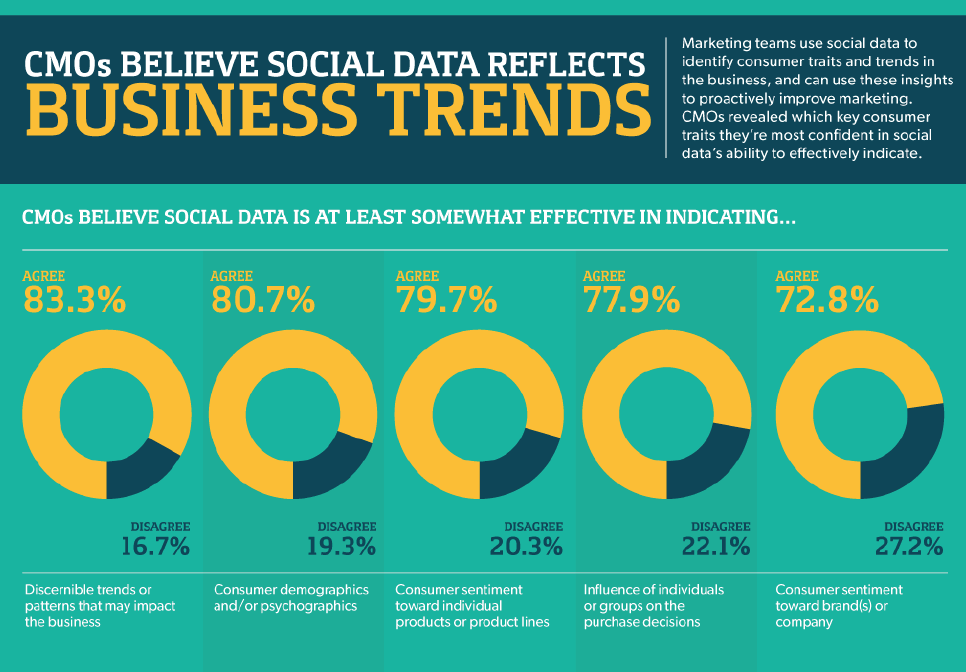
It would also appear that CMOs realize that social media is a direct reflection on the world around them – the world where consumers live, work and play. While not crazy about the use of the word “somewhat” again, the graph below shows that a large number of CMOs surveyed believe that social media is effective for identifying discernible trends among consumers with the word “discernible” being the operative word for sure.

The graph also reveals how CMOs believe that social media does a great job at reflecting consumer sentiment.

CMOs Are “Customer Champions”

Erin Mulligan Nelson, CMO, Bazaarvoice used that term in discussing the findings of the survey, saying “In a consumer-obsessed C-suite, the CMOs are the chief customer advocates and social (media) data is their ultimate weapon. Social data lets CMOs truly know their customers and predict consumers’ future needs before they even have them. Nearly all CMOs now use this data to drive decisions. As the business world re-centers around serving and delighting consumers, social data is turning CMOs into customer champions — and heroes within the C-suite. And as an industry, we have just started to tap into the potential of social data.”

She is dead on when she says that we have just started to tap into the potential of all the social media data of course as we are just now beginning to realize the sheer magnitude and power and scope of the mounds of data. Given the fact that we as consumers now create as much information every two days as we did from the dawn of civilization to 2003, I would say Acxiom CMO Tim Sutherwas correct when he referred to it as a ”tsunami of data” in an article I wrote back in February entitled How To Rein In The Riches Of Big Data.

The aforementioned article also speaks to the inherent dangers brands and businesses face when deciding what to do with all this new found data and the possible legal ramifications therein.

Sources: CMO.comBazaarvoiceThe CMO Club

Named one of the Top 100 Influencers In Social Media (#41) by Social Technology Review and a Top 50 Social Media Blogger by Kred, Steve Olenski is a freelance copywriter/blogger looking for full-time work. He has worked on some of the biggest brands in the world and has more than 20 years experience in advertising and marketing. He lives in Philly and can be reached via email,TwitterLinkedIn, or his website.