 One of my LinkedIn connections (Phil Masiello) recently asked me an important question – one that, in my opinion, everyone should be asking themselves if they haven’t already. Following is his question, with my response and a few additional thoughts:
Phil: Ted,
I have my Twitter linked to my LinkedIn account. One of my contacts is complaining to me that I shouldn’t do that. Linked in is for business and Facebook is for other. My twitter is mostly related to business, business travel, etc. What is your thought? Should I take twitter off LinkedIn?
My response went something like this:
I connect my Twitter activity to my Linkedin account because I do very little daily LinkedIn interaction and this way my LinkedIn presence still has a life. I DO NOT connect Twitter to Facebook since those posts do fill up peoples pages and cause issues, and the language I use for Twitter and Facebook differs so greatly.
I have had a few LinkedIn complaints as well (about showing my Twitter activity there), but those complaints are HUGELY outweighed by the positive feedback and interaction it creates for me in a medium that lacks that easy functionality. I explain this to those who complain, and they all understand my reasoning. That being said, if they are unhappy, they can simply unlink from me, with no harm done.
I DO pay attention to these things and if the negative begins to outweigh the positive, I will change my practice.
The key things to ask before linking any social media streams are:
- Is the information relevant to more than one network? If not, don’t link.
- Is the language (tone, formal vs. informal, etc) appropriate for more than one network? If not, don’t link.
- Is the content valuable to more than one network? If not, don’t link.
- Is the content appropriate for the purpose of more than one network/tool? If not, don’t link.
- Is the link (and resulting automatic feed) likely to get in the way of other people’s online experience? If so, don’t link.
Although each social media tool has several shared attributes, each tool also has different functionality and different purpose – which draws a different audience and content for each.
Bottom line? Pay attention to your audience and make sure your links between tools are of value to each audience involved, and not just an easy (but useless) way for you to spray your content far and wide. Just because you CAN doesn’t mean you SHOULD.
On the other hand, when done intentionally and appropriately, linking content feeds from one social media tool to another can be a highly effective and valuable way to extend your online presence to more than one relevant audience in more than one way.
Bottom line? It’s your choice… just choose wisely, for the sake of all involved.
Ted Rubin
PS. Notice how Phil used social media to request information from a trusted source. LOVE it!
Originally posted at Zemoga’s FromBogotaWithLove.com
 In the traditional model, you can only play one program at a time. One radio show or one movie or one show…
 “Women control the majority of purchasing decisions in a household and their influence is growing.” That’s just one of the many key findings from a Nielsen Study which showed that women the world over are in control of purchasing decisions which should serve as a wake up call to business to consumer (B2C) marketers and advertisers across the globe.
  Guest post from Courtney Sato, Community and Brand Director at the Constellation Research Group.
 The state of social media is no insignificant affair. Nor is it a conversation relegated to a niche contingent of experts and gurus. Social media is pervasive and it is transforming how people find and share information and how they connect and collaborate with one another. I say that as if I’m removed from the media and cultural (r)evolution that is digital socioeconomics. But in reality, I’m part of it just like everyone else. You and I both know however, that’ I’m not saying anything you don’t already know.
 A well-structured contest — wisely integrated in social media, encouraging participation of groups, and easily enabling the sharing and including of the social graph of participants — will bring consumers into your brand experience. Savvy marketers can leverage contests to increase both short- and long-term return.
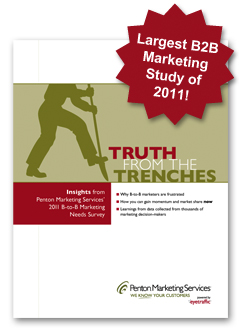 Penton Marketing Services, a division of Penton Media, announced today the release of “
 There are so many things in life that we simply cannot control (as is especially clear right now, around the 10 year anniversary of 9/11), but what about the things we CAN control? As human beings, we have the power of reasoning and choice, both of which give us substantial control over our own life situations… we just need to be reminded of this from time to time. Following is my reminder list of the 12 Most Important Things We All Control:
 Earlier this year, Marketo conducted a