Slow journalism

Slow journalism comes to me so naturally that I’ve taken about five years to write about it.

On Wednesday morning, the Today programme (I cannot wake up without Radio 4′s good-natured, grumble-fest; that delicate blend of warm-crumpet humour and stern, stentorian urgency is the perfect mental espresso) was so interesting that I was moved to switch off the Babyliss. Following Al Jazeera English’s rolling coverage of the Egyptian protests, Marcus Webb, director of the Slow Journalism Company, and former director of BBC Global News Richard Sambrook, were discussing the missing ‘sense of perspective’ in our always-on reporting culture.

Webb was touting his new luxury print quarterly Delayed Gratification, which:

distils three months of the UK’s political, cultural, scientific and sporting life into a witty magazine of record. A combination of almanac, essays and reportage, Delayed Gratification operates on the principles of Slow Journalism, offers an antidote to throwaway media and makes a virtue of being the last to breaking news. Its publications are beautiful, collectible and designed to be treasured.

Gosh. I delayed my gratification for all of an hour, and subscribed as soon as I got to work.

Read more

Presenting Through the Hourglass

You have 15 minutes to deliver a presentation that was constructed for 45.

We’ve all been there. My first ever professional presentation happened in 1996 and was to convince my then SVP of Sales that we needed to build a Web site for the company. I had a great deck put together. A carefully crafted script and a slew of charts and handouts to make the case over the course of the scheduled hour. The SVP runs in late and says, “Wion. You got ten minutes. Go.” I quickly made the case as best I could. He didn’t bite. Early #fail.

In fact, I’ll never forget his words. “You’ve put together a well thought out proposal based on the amount of paper here. But mark my words…this Internet thing is a fad. In two years, no one will remember what it is.”

Read more

Program or Be Programmed: 10 Commands for a Digital Age


Thanks to digital technologies and networked activity, we’re living through a global transition that is redefining how culture and commerce operate. We’re presented with the opportunity to be active participants in this process, steering ourselves into new modes of civilization, verse being just passive spectators.  But if we don’t understand the biases of the tools and mediums we’re using, we’ll risk being slaves instead of masters.

This is not the first time this has happened, but it may be the most significant one so far. Every media revolution has given the people a sneak peek of the control panel of civilization, and a chance to view the world through a new lens. When humans developed language, we were able to pass on knowledge and experiences, and allow for progress. We could both listen and speak.

Read more

How should you treat your best customers?

Here’s what most businesses do with their best customers: They take the money.

The biggest fan of that Broadway show, the one who comes a lot and sits up front? She’s paying three times what the person just three rows back paid.

That loyal Verizon customer, the one who hasn’t traded in his phone and has a contract for six years running? He’s generating far more profit than the guy who switches every time a contract expires and a better offer comes along.

Or consider the loyal customer of a local business. The business chooses to offer new customers a coupon for half off—but makes him pay full price…

If you define “best customer” as the customer who pays you the most, then I guess it’s not surprising that the reflex instinct is to charge them more. After all, they’re happy to pay.

But what if you define “best customer” as the person who brings you new customers through frequent referrals, and who sticks with you through thick and thin? That customer, I think, is worth far more than what she might pay you in any one transaction. In fact, if you think of that customer as your best marketer instead, it might change everything.

Seth Godin

The Interest Graph on Twitter is Alive: Studying Starbucks Top Followers

Social media is maturing as are the people embracing its most engaging tools and networks. Perhaps most notably, is the maturation of relationships and how we are expanding our horizons when it comes to connecting to one another. What started as the social graph, the network of people we knew and connected to in social networks, is now spawning new branches that resemble how we interact in real life.

This is the era of the interest graph – the expansion and contraction of social networks around common interests and events. Interest graphs represent a potential goldmine for brands seeking insight and inspiration to design more meaningful products and services as well as new marketing campaigns that better target potential stakeholders.

While many companies are learning to listen to the conversations related to their brands and competitors, many are simply documenting activity and mentions as a reporting function and in some cases, as part of conversational workflow. However, there’s more to Twitter intelligence than tracking conversations.

Read more

The Discipline of Social Media Measurement

We hate math.

Our abhorrence for calculation enables us to mutually agree on statistically dubious metrics with nary a shrug or arched eyebrow.

Consider Nielsen ratings, which are used to determine the popularity of all TV shows and, consequently, how the dozens of billions of dollars in TV advertising is apportioned.

Nielsen ratings have a direct impact on hundreds of thousands of people in the United States. In 2009, there were 1,147,910 households with a TV in metropolitan Charlotte, North Carolina. Of those more than 1 million households, the behavior of just 619 was tracked by Nielsen to determine ratings. A total of 619 families became the unelected representative tastemakers for 1,147,291 other families. That’s not math; that’s folly.

Read more

How do *You* define ‘Best Customer’?

Seth Godin has it exactly right when he asks in a recent blog post, “…what if you define ‘best customer’ as the person who brings you new customers through frequent referrals, and who sticks with you through thick and thin?”

In other words, what if we define “best customer” as “strongest Brand Advocate”?  How would that change the way we think about and treat our Brand Advocates?

Read more

How to alienate a customer in just three easy steps

The really great thing about social media is this: it’s faster and easier than ever to ignore, alienate and piss off a customer!

Case in point. As quick background, I joined Weight Watchers 9 days ago (not that I’m counting). It’s not a brand I ever thought I would associate with, but, well, that Jennifer Hudson TV commercial sucked me in, to tell you the truth. I know how to lose weight (lots of experience), but counting calories has gotten tedious so I thought maybe there’s something to this whole “points” thing.

Read more

The Antidote to Negative Commentary

As much as we might not want to admit it, something negative about our brand will be said sometime by someone in a social network.  It might be due to a change, or something out of the brand’s control or only one little misstep in many months, but chances are, that unfortunate experience will be shared.   Such is the nature of information-sharing through social networks.

But it’s that same nature of social media that also gives us a powerful antidote to negative commentary – ENGAGEMENT.

We might be tempted to cover any negative feedback with a huge push of positive messaging, stating and re-stating how wonderful our products and services really are. This attempt at damage-control, however, does little if anything to protect our brand reputation.  Whether or not our products and services are usually terrific doesn’t matter to the person who had a different experience with our brand, nor to those closest in their social network.  What matters to them is the one unsatisfying experience they had.

This is where engagement becomes vital.  We can stay disengaged and pretend nothing negative was said, but ignoring those comments won’t keep them from spreading quickly through various social networks.  If we choose instead to engage with the consumer(s) making those comments, we have a huge opportunity to help positively change the perception of our brand.

Read more

Why you may want to know what a wikibrand is

All of you wonderful marketers, public relations, advertising and communications folks out there who have a lock on and already have a dialed in plan for social networking and the impact it will have on your brand and/or business need to read no further. For the rest of you, I suggest you may want to learn what a wikibrand is.

After beginning the book with a short history of on brands and the phases of brand development since 1860, co-authors Sean Moffitt and Mike Dover compare the period of transition to social we are now currently in, to the Mad Men period of transition from radio/print to television.

But the power to be gained by transitioning to a wikibrand mindset really comes from recognizing and developing a better understanding of, then leading your organization across the Marketing Divide (see below graphic). Even more importantly, the book explores how marketers, through leading the migration across this divide to a social future, have the opportunity to again elevate the marketing function to it’s rightful place leading the parade of an engaged and dynamically connected company and it’s community of customers.
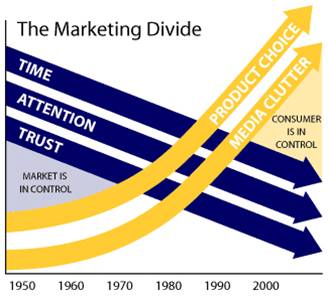
The Marketing Divide

Not sure if this is another Mad men reference, but the authors also lay out and detail their FLIRT concept which represents Focus, Language and content, Incentives, motivation and outreach, Rules and rituals and lastly Tools and platforms. This represents the construct Moffitt and Dover recommend to build out a wikibrand and I will leave it to the authors to further convey as they explain fully in the book.

Once you’ve mastered the concepts around flirting, it’s time to get your wikibrand show on the road with what they describe as “Incubating Your Wikibrand Community” including sharing insightful methods for community development, internalization, management and of course measurement & metrics.

Wrapping up, in his Foreword to the book, “Reinvention of the Brand” Don Tapscott suggests this may be a seminal work and I tend to agree. I say this because too many marketers out there are still treating social as an oddity and handling it with their kid gloves. If Wikibrands does nothing else(and it does), it should through the logical analysis and evolutionary brand progression provided, lead marketers still offside with social to the realization that it is far from an oddity, but rather a portal to our emerging future.

Jeff Ashcroft

@TheSocialCMO

Full disclosure: For purposes of transparency, we did receive a review copy of the Wikibrands book.